

'We Cannot Stop Being the Voice for Those Who No Longer Have One.'
What ZAKA saw. Plus: Fire destroys Jewish funeral facility + good news for food.
Seward Park Funeral Facility Destroyed in Fire
Early Tuesday morning, the Jewish funeral facility in Seward Park went up in flames, the second catastrophic fire in the South End’s Jewish community this year.
The fire broke out in the garage, which is used for building traditional wood caskets used for Jewish burials. It spread through the building including to an attached apartment. The renter escaped unharmed, and two bodies in the refrigeration unit were safely removed.
“Initially, when I first got there, around 3:40 in the morning, there was a large number of firemen there already,” says Joe Greene, Seattle Jewish Chapel Funeral Director. “It didn’t look so bad, but then they started cutting out the garage door, and we started seeing larger flames.”
The cause of the fire is still under investigation. Charred beams above the garage point toward an electrical fire in the ceiling, but this has not been officially confirmed. The full extent of the damage has yet to be assessed.
“After everything was done, it looked very devastating,” Greene says.
The main function of the building is to perform a ritual called tahara, which means purification. The chevra kadisha (a “holy society”) ritually wash and enshroud deceased Jewish individuals and place them in the casket immediately before burial. According to Greene, 100 percent of Orthodox and Conservative Jews and about 10 percent of Reform Jews opt for tahara. Approximately 150 decedents pass through the tahara facility each year, including those in transit for burial in other locations.
For the time being, taharas will be handled at a funeral preparation facility in Kent.
“We are doing everything we can to ensure there is no interruption in service,” Greene says. “The time may extend by a day, but other than that, we’re confident everything is going to be uninterrupted.”
In February, a fire tore through the kitchen at Ezra Bessaroth, leaving the adjacent social hall and youth wing with crippling smoke and water damage. Renovations to that structure are still underway.
This is also the second funeral home in the neighborhood to burn down. The historic Columbia Funeral Home on Rainier Avenue South was torched by an arsonist in July of 2025.
Aviv Hummus Bar Goes Kosher
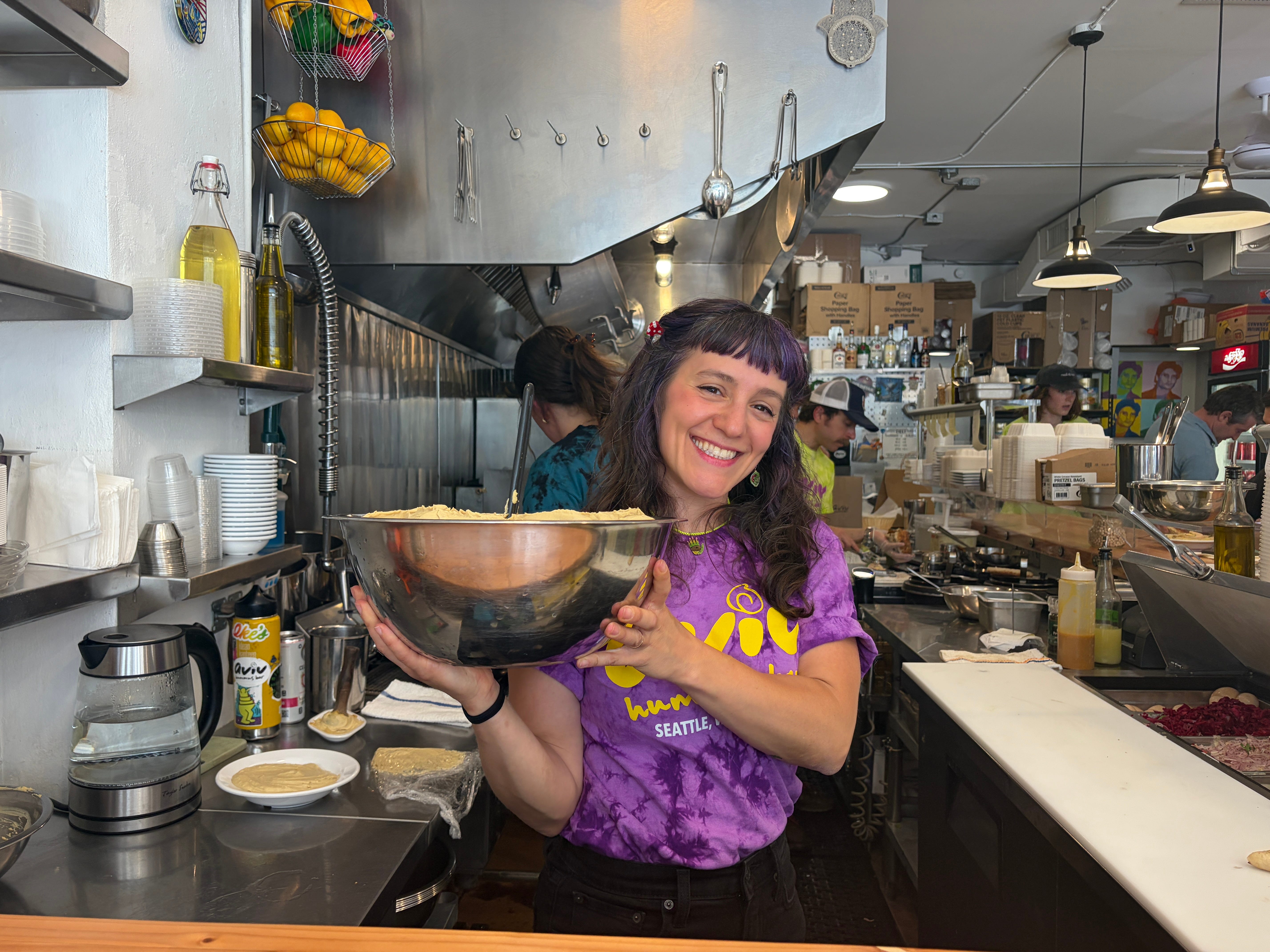
Aviv Hummus Bar, an Israeli street food cafe on 15th Avenue on Capitol Hill, celebrated a grand re-opening on Tuesday after undergoing kosher certification. David and Jodi Nussbaum opened Aviv in 2017 (David actually proposed to Jodi in the restaurant a week before it opened) and have managed to overcome the hurdles of restaurant ownership that see so many establishments fail.
With that success under their belts and the rising awareness of what a post-October 7th world means for Jewish and Israeli businesses, the Nussbaums took the plunge into kashrut certification.
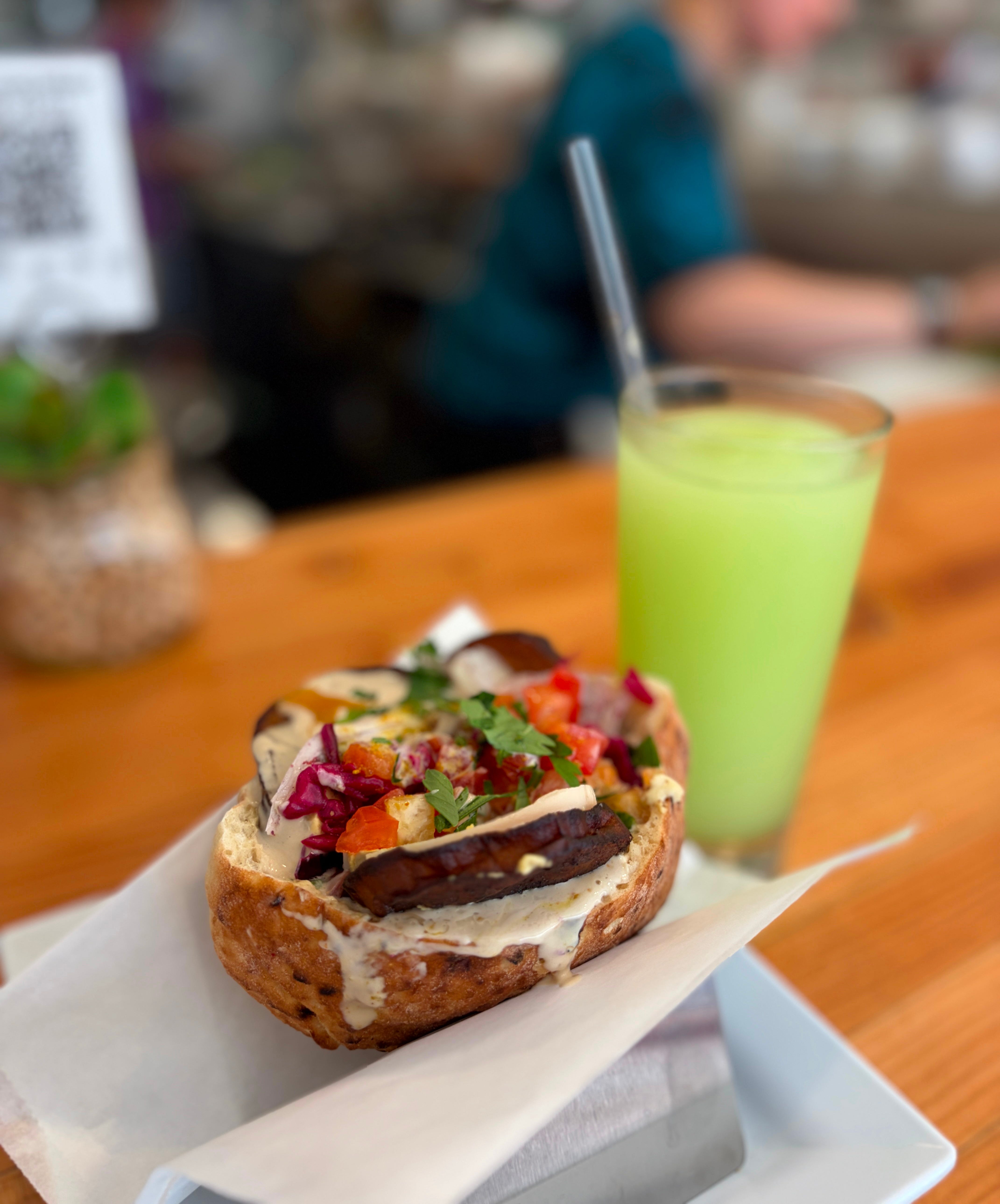
The Cholent sat down with Jodi Nussbaum over a very messy and highly delicious sabich sandwich and frozen lemonade to discuss the transition.
The Cholent: How has it been running an Israeli restaurant for the past 10 years?
Jodi Nussbaum: You know, I was really nervous when we first opened, because we’re in Capitol Hill. I used to wake up at night and check the cameras and make sure everything was okay. That died down after a while because we really didn’t experience much in terms of anti-Israel conduct until October 7th.
Our window was broken around October 14th, and there have been a few incidents that just made us realize things had changed. Especially online, we’ve had one-star review bombing campaigns pretty frequently. I turned off my notifications. I don’t even look anymore, because it’s just too painful.
Business has been slower, and it’s also been a realization of who’s really there for us at the end of the day. I think that led us this year to become kosher, because the people who are there for us, at the end of the day, are us.
How hard was it to become kosher? I assume you’ve been approached many times.
It was probably the number one question people asked us: “Are you kosher?” or “Would you ever consider becoming kosher?” It was a question we got often, but our impression was that there was going to be a lot more red tape than there actually was.
It ended up being a really positive experience overall. The first time we spoke to the Vaad was less than a month ago, so we really hit the ground running and decided to make the transition very quickly. In that sense, it really was fast, but it was a lot of work. The only mandatory closure was for 24 hours, but we decided to do a complete refresh of the restaurant. The biggest issue was really the dishes. We did a full deep clean from top to bottom.
How has becoming kosher been received?
I don’t know if our regular clientele is aware of the transition, because we intentionally marketed it differently. Within the Jewish community, we wanted everyone to know we were becoming kosher. To the general public, we said we were renovating and refreshing the menu and the restaurant. Who needs extra attention in this climate for being Jewish?
We wouldn’t have been able to do this financially without community support. We raised $20,000, mostly from people we didn’t know. Some of our non-Jewish friends contributed as well, simply to support the restaurant and Jewish culture. It really was the full spectrum: people who keep kosher, people who don’t keep kosher, people who had eaten here before, people who never had. I think it showed just how much demand there is for a kosher restaurant in Seattle.
I keep coming back to October 7th because it’s hard to look at life any other way now. Some people chose to hide who they are, turn away from it, denounce it, or make excuses. We felt the opposite. We don’t necessarily want to advertise our Judaism to the broader public, but we want to fully embrace who we are. We’re not hiding. We’re still here. We’re just trying to avoid the online mobs. But here, we’re realizing how important it is to be authentically ourselves and not pretend to be something we’re not.
From the bottom of our hearts, I just want to thank everyone. I really think this is going to be a very good thing.
Aviv Hummus Bar is located at 107 15th Ave. E, Seattle.
Poll of the Week
With the DSA wins in NYC this week — alongside Mayor Mamdani’s AIPAC monster comment — and our own primaries coming up in August featuring Keffiyeh Kshama trying to unseat Adam Smith, how close should we be to hitting the panic button?
“God Gave Me this Ability.”
This week, representatives from ZAKA on a West Coast tour stopped by Seattle to meet with the FBI and with a small group of Jewish community leaders at the invitation of the Federation.
If you hadn’t heard of ZAKA before, you probably became aware of them after October 7th, when the search-and-rescue volunteers rushed to the massacre sites to collect bodies, blood, and whatever remnants they could gather to ensure victims could be buried with dignity and in entirety.
ZAKA responds to disasters around the world and was here to meet with the FBI to discuss the sensitivity around Jewish victims. The nonprofit, which has some 4,000 volunteers, responds to tragedies around the world, from a recent plane crash that killed three Israeli men in Maryland to the floods in Texas last summer that devastated a Christian girls camp.
And, October 7th: a disaster that challenged the toughest ZAKA volunteers, even commander Simcha Greiniman, who couldn’t go back to his carpentry work because the images of blueprints triggered him.
Greiniman has spoken before the UN and was interviewed for Sheryl Sandberg’s documentary about sexual violence, Screams Before Silence.
Greiniman sat down with The Cholent to discuss the work of ZAKA and what he experienced on October 7th.
Warning: this interview contains depictions of violence. The interview has been edited for length, clarity, and some graphic details.

The Cholent: How did you end up getting involved with ZAKA?
Simcha Greiniman: My father passed away when I was five years old, very young. The loss of my father put me in a situation where every person finds their connection to something. My connection came through understanding that the way to connect with my father was through doing good. I made it my purpose in life to help people.
When I was about 16 and a half I started volunteering with Magen David Adom during the First and Second Intifadas. After saving whoever was able to be saved, I saw these guys with yellow vests that said “ZAKA.” I said, “What are they doing here? We’ve already taken out everyone who was injured. Why are they coming onto the scene?”
I was told they were coming to give dignity and respect to the people who died — not only for them, but also for their families — helping bring them to burial in the proper way. I said, “Wow. That’s exactly how I could connect to my father: giving back to someone who can never give me back whatever I’m doing for him.” I felt I was building the bridge I never had with my father.
Can you explain the mission of ZAKA to collect every bit of blood? Why is this so important?
Let’s go back to what burial is at all. What’s the whole purpose of it? When God created the world, He gave Adam his name. Adam stands for the three letters aleph, dalet, mem. We know that in the Bible it says that from the earth we came — that God created humans from the earth — and to the earth we should return.
So it’s important to be buried properly. But more than that, if you look at the letters, aleph stands for God (Elokim), and dalet-mem [dam] stands for blood.
A human can survive without a limb. We see soldiers after unbelievable situations losing arms and legs, and they’re still alive. Some of them have no limbs at all, and they’re still alive. They’re happy and they’re living.
But a human without blood cannot survive at all. It says in the Bible that the soul leaves the body through the blood. Which exact drop of blood is part of the soul? We don’t know. So if you really want to respect the person who just died — whether in a car accident or even an elderly person — every drop of blood could be part of that nefesh [soul]. Through that, we understand how important it is to respect and collect all of it.
Can you talk a bit about how you handled the October 7th massacre?
It was a very, very powerful experience going through those houses during the two and a half weeks we were collecting bodies. You’re working like a soldier. You’re not really looking, and you’re not paying attention to what you’re dealing with in those moments because you’re focused on the mission.
If you don’t collect the bodies and bring them to the morgue, some of those bodies — or parts of them — could be taken into Gaza. Whatever you leave behind on the highway could be taken. So it was about doing everything as quickly as possible, even while under fire.
Then, for another 14 and a half weeks, things were calmer. Still frightening, but different. We weren’t just collecting bodies anymore. We were going back into the houses. That’s when you started remembering what you had seen.
A lot of volunteers returned to those scenes. You’d go into the room of an elderly Holocaust survivor who had been connected to oxygen and other medical equipment. You’d remember what she went through, and you’d think, “We collected all her remains because of what happened to her.”
But then, when you come back to that same room and you have hours and hours to work there, you reach a certain stage where you say to yourself, “Wow. How could it happen? How could it be?”
And if you don’t have a strong belief in God, it’s very difficult.
How does God help in those situations? I understand you have secular volunteers, too. How are they able to cope?
The purpose is understanding that what you’re doing is something God gave you the ability to do. Not everyone is able to see a cut or even a drop of blood. Here, you’re facing the worst situations that people’s bodies can go through.
God gave you the ability to do this, and it’s a privilege. Not everyone is capable of doing what I’m capable of doing. But I’m not a banker or an accountant. God gave me this ability.
From October 7th until now, I had been working in carpentry and helping at-risk youth and people dealing with mental health challenges. Now my calling is to leave the carpentry and become more involved in caring for humanity around the world — showing, teaching, and training people to be part of chesed [kindness].
You were witness to scenes of sexual violence. Are you able to talk about what you saw and what you’ve brought to the public as one of the faces of ZAKA?
During the two and a half weeks when we were collecting bodies and remains, I was assigned to places that left an unbelievable impression because of what we saw and what we dealt with.
Personally, when you come to certain places — a suicide scene or a terror attack — you see certain things. You see gunshot wounds. You see someone who took their own life. It’s tragic, but you can understand what happened at that scene.
Here, when we entered these houses, we kept seeing things that were not normal. First of all, between 80 and 85 percent of the people had been shot at point-blank range, not from a distance.
A lot of people — men and women — had been shot in intimate areas in ways that were not normal.
They were shot there as part of the torture?
Yes. Part of the torture.
Then we came to houses where we saw women in conditions you cannot imagine. In one house, a woman had had her breast cut off. In another case, a woman had objects inserted into intimate areas. I have all the evidence showing me as a commander with my team going through those houses on specific dates, house by house in the kibbutzim.
We have live video and still photographs showing every step of what we encountered, from entering the house to entering the bedrooms and documenting what was there.
So there is no question about what I personally witnessed. We have evidence documenting it. When I came to the UN, I stood before the world and said, “This is what we dealt with.” ZAKA is recognized by the UN as an international search-and-rescue organization that responds to disasters around the world.
After helping people in so many countries, suddenly people were questioning our work. If we are recognized by the UN as a search-and-rescue team, then we’re standing there on your behalf. It doesn’t matter whether it’s Israel, Turkey, or anywhere else in the world.
When it happens in our own backyard, and we come with full evidence, and people deny it or refuse to speak about what happened to these women, it’s very hard for us. But these are the facts.
I wanted to ask about that. I’ve heard that the UN has questioned the evidence because it wasn’t processed properly because of the mandate to bury the dead quickly and with dignity.
They came up with an easy answer. While I was sitting with UN specialists who were questioning us, one of the questions they asked was, “Why didn’t you have a rape kit with you?”
I asked them, “Is there any first responder in the world who carries a rape kit? Does any ambulance anywhere in the world have a rape kit inside it?” No. And when a woman experiences a sexual assault, the examination has to be done properly in a hospital. So what they were asking me was nonsense.
Then they said they couldn’t confirm what happened because there wasn’t enough evidence. My videos and photographs weren’t enough. They wanted additional investigation. To me, that’s nonsense.
When you see the videos and photographs, it’s easier simply to keep raising the bar for what counts as evidence and say, “It didn’t happen,” or “There isn’t enough proof.”
I represent the UN around the world, and then they’re questioning me. A woman who survives an assault has to stand there and prove what happened to her. These people can’t speak. They’re dead. We’re there to be their voice. That’s why I’m doing what I’m doing.
Even if people had initially said, “Some of these things happened, but we don’t yet have evidence for all of them,” that would have been one thing. But since then, lawyers and specialists from around the world have come to Israel. They’ve gone through the morgues. They’ve examined the bodies.
Many of those women had gunshot wounds to their vaginas and to other intimate areas. When you see the same pattern once, twice, three times — over and over again — it isn’t something that happened by chance. It becomes a systematic pattern of assault.
And then people still say, “No, it never happened,” or “We don’t have enough evidence.”
It bothers me deeply, but I can’t do anything about it.
You traveled to New Jersey and were met by a protest saying “stop ZAKA’s lies.” How do you move through the world knowing that people think, after all you’ve seen, you’re simply lying?
My first trip after speaking at the UN included a visit to a community in Teaneck, New Jersey. While I was flying from Israel to the United States, I turned on my phone and saw the slogan, “stop ZAKA’s lies.”
My flights usually leave after Shabbat. I waited until Shabbat ended in America and then wrote to the rabbi, saying, “I’m not going to come if the whole community is going to suffer because of me.”
He said, “No. You have to come.” Then he sent me a letter signed by 72 rabbis from different communities saying everyone should come out to support ZAKA. There were close to 10,000 people. The streets were filled. They were blocked off. There was music. It was unbelievable.
I began my speech by saying that there is a time for everything in life. Every place I go and every moment I’m there is part of God’s plan. Looking back, I believe I was meant to be there — not to speak to 25 or 60 people, but to thousands. It showed me how important it was.
Yes, there are people in the world who deny that the Holocaust happened. There are people who deny what happened on October 7th. But we cannot stop speaking. We cannot stop being the voice for those who no longer have one. It’s important that we continue.
Announcements
Check out the Seattle Jewish community calendar.
Candlelighting in Seattle is at 8:52 p.m. The parasha is Chukat-Balak.
Send shoutouts and announcements to thecholentseattle@gmail.com.
Mahjong Retreat Labor Day Weekend
Join us at Camp Solomon Schechter for “Mahj & More,” Friday, September 4 to Monday, September 7. This fun-filled, adults-only getaway features mahjong, great kosher meals, community, and camp activities. Whether you want to learn mahjong, advance your game or just play all weekend, this getaway is designed for everyone. Early bird discount ends July 10. Learn more: www.campschechter.org/mahj/
Travel to Spain with Jewish History Tours: October 18-29, 2026
Join for an extraordinary travel opportunity to learn about Sephardic history and the Golden Age of Spain through walking tours, world heritage sites, and lots of delicious food and wine. The tour will begin in Barcelona and then continue to Andalucia to Granada, Cordoba, Seville, Madrid, and Toledo. We offer small group travel, 4–5-star boutique hotel accommodations, smart local guides, and of course, lots of tapas!
For all the details, itinerary, and pricing - go to: https://www.norakaplan.com/spain.html#/
This will be the 5th tour in partnership with Moises Hassan of Jewish Spain Tour and Qesher with group leader and local Seattleite, Alexis Kort.
Contact Alexis via cell phone at 347-446-1422 or email alexis.learnintrips@gmail.com
I cannot comprehend the degree of anger, resentment, and hatred that possess humans to commit murder, rape, and mutilate other human beings to such an extent as what happened on Oct 7. It's not the only time in history.
It goes beyind that. Watch Reem Alsalem, UN Raccontur, supposedly investigating international violations of women, rape, etc, response to a victim's portrayal of rape and torture on Oct 7.
It was an icy cold indifference. Unsympathetic. Unapologetic. Uninterested. Unhuman. Uneverything.
It's not just antisemitism. It's immorality.
It's an attitude that has metastsized as a cancer through humanity and so clearly manifested through UN and Alsalems indiference.